
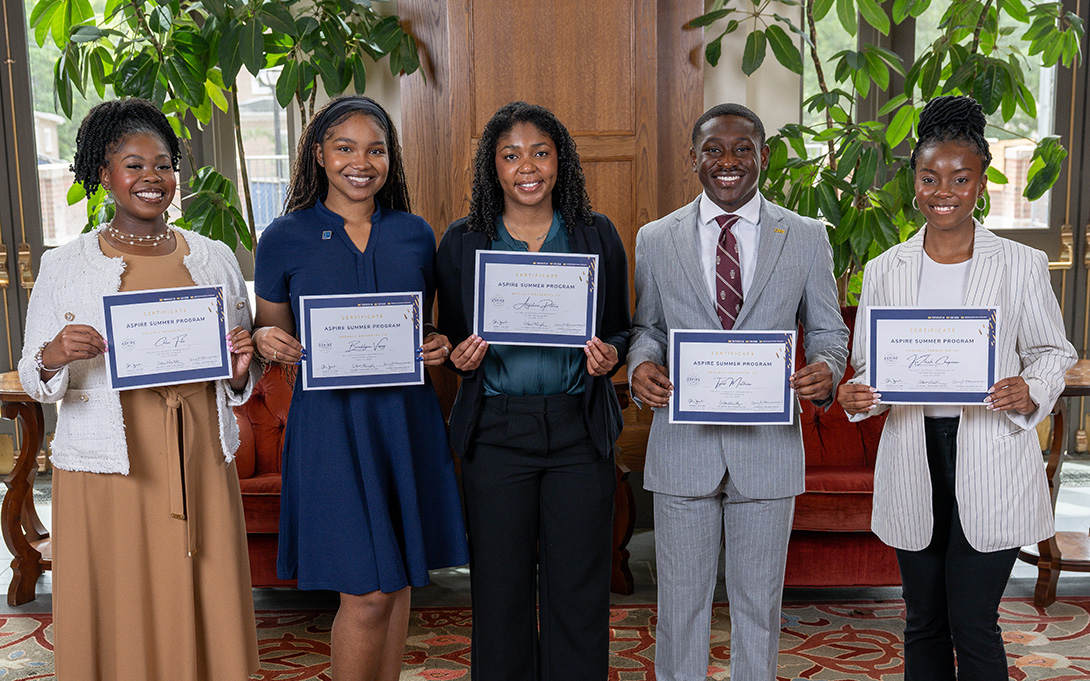
Rising Morehouse College senior Tyler Mathieu had one goal in mind when he arrived in Ann Arbor for the Applied Social Policy Internship and Research Experience (ASPIRE): stay open-minded. “When I applied, it was a shot in the dark,” he said. “Now I can say it was the best decision I could have made for the summer. Originally focused on becoming a school superintendent, Mathieu’s ASPIRE experience broadened his perspective. “Being introduced to public policy through this program has really changed my mind about what I want to do after graduation,” he said. “Now I’m considering a dual degree in education and public policy, and I want to attend Michigan for [graduate] school.”
The eight-week summer program run by the Youth Policy Lab (YPL), a joint program of the Institute for Social Research and the Ford School of Public Policy, offers hands-on experience in applied social policy research for rising juniors and seniors at Spelman College and Morehouse College. Mathieu, along with Spelman students Ke'Zhiah Chapman, Chloe Fite, Angelica Pierce, and Brooklynn Vesey, each developed independent research projects from a shared dataset, the Youth Risk Behavior Surveillance System (YRBSS), which measures health-related behaviors and experiences that can lead to death and disability among youth and adults.
Drawing on their individual interests, the students explored topics ranging from teen dating violence to the impact of childhood trauma on school engagement.
“I’m really interested in how people’s environments and experiences shape their health outcomes and behaviors,” said Angelica Pierce, a rising senior majoring in sociology with a minor in public health. “My research project looked at how adverse childhood experiences (ACES) impact students’ likelihood to engage in risky sexual behaviors, and I wanted to see whether having support systems like trusted adults or responsible friends made a difference in reducing those risks.”
[My project] looks at how parental incarceration impacts adolescent mental health and increases the risk of further adverse experiences,” said Brooklynn Vesey, a rising junior majoring in health science with a minor in cosmetic chemistry. “My grandfather was incarcerated, and seeing how it affected my mom and her siblings drives me to share these stories and push for more support for these families.”
Based on feedback from the prior two years, ASPIRE offered students more support—more office hours, more hands-on instruction—to help them navigate challenges in their research.
“After getting our dataset I had 1,000 questions,” said Chloe Fite, a rising junior majoring in economics with a minor in public health. “I worked a lot with YPL co-director Robin Jacob and PhD student J’Mauri Jackson. They were very helpful when it came to helping me narrow down my [research] question so I could actually see the impact of my data.” Fite’s final project examined how exposure to non-sexual violence could increase the likelihood of experiencing sexual violence among high school students. Her presentation highlighted the importance of early intervention and trauma-informed support systems for youth.
In addition to building technical skills, the cohort met regularly with guest speakers from various sectors including academia, philanthropy, and public service. Several were returning guests from previous ASPIRE summers, including Marijata Daniel-Echols of the W.K. Kellogg Foundation and former State Representative Felicia Brabec. Others were new to the program this year, such as Washtenaw County Public Defender and Spelman alumna Delphia Simpson and Sean White, the Director of Strategy and Civic Partnerships with Michigan Central.
“Watching how speakers and YPL staff carried themselves taught me a lot,” said Ke'Zhiah Chapman, a rising senior majoring in economics with a minor in political science. “One highlight was connecting with the new Morehouse president Dr. F. DuBois Bowman over dinner; as a Spelman student, it meant so much to see that HBCU bond in action. I was also surprised by how strong the Spelman-Michigan network is—I kept running into Spelman alum everywhere, even in the laundry room at our dorm! It made a big place like Michigan feel a lot more like home.”
The students presented their findings at a capstone presentation on July 25 where, despite their differing projects, they offered policy recommendations that converged around common themes: the critical role of supportive adults in young people’s lives and the need for schools to prioritize healing and intervention over punitive discipline. “I wanted to tell a story about the disproportionate challenges faced by African American male students,” said Mathieu. “This project challenged me and deepened my passion for promoting better education for the African American community.”
Applications for the 2026 ASPIRE program are accepted in late winter. If you would like to be notified when applications open, please email [email protected] with ‘ASPIRE’ in the subject line.
About the Youth Policy Lab (YPL)
The Youth Policy Lab, a joint research center of the Gerald R. Ford School of Public Policy and the Institute for Social Research, envisions a world where partner-driven and policy-centered research fuels positive social change. Our mission is to inform public policy decisions that impact youth by analyzing data and evaluating programs to help society answer its most pressing questions.
More news from the Ford School