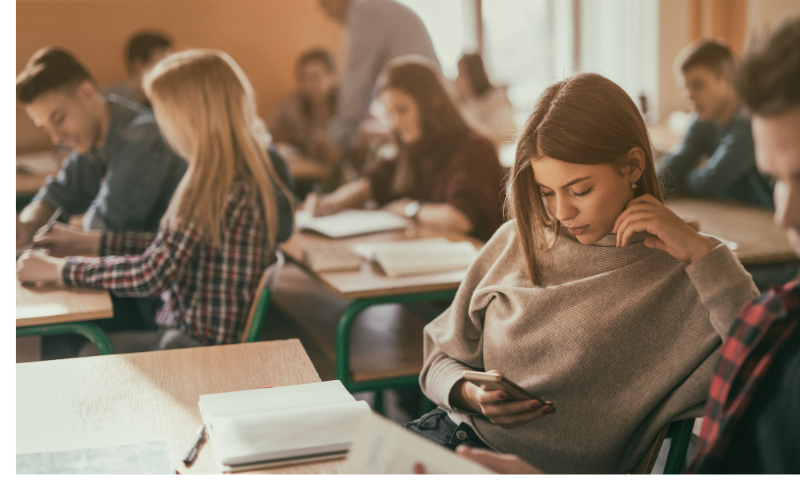
Wisconsin recently became the 36th state to enact a law limiting cellphone use in K-12 schools. The measure passed with bipartisan support. When Gov. Tony Evers signed the bill, known as Act 42, he said that cellphones can be "a major distraction from learning, a source of bullying and a barrier to our kids' important work of just being a kid."
These positive social results are consistent with the findings of a national study looking at the effects of school phone bans, published earlier this week by the National Bureau of Economic Research. Researchers looked at attendance rates, test scores, teacher and student surveys and other data from more than 40,000 schools between 2019 and 2026.
Schools that required students to place their phones in a lockable pouch for the day saw a significant decrease in nonacademic cellphone use among students, dropping from 61 percent to 13 percent, according to the study.
"We also found that teachers in schools that adopted the pouches were generally satisfied and happier than they were prior to pouches," Brian Jacob, a public policy professor at the University of Michigan and one of the report authors, told "Wisconsin Today."
Student well-being also went up as phone use decreased, with teachers and staff noticing more chatter and smiles throughout the school day.
While some educators thought that phone bans would lead to better academic performance, schools with strict phone policies did not see increased attendance or higher test scores, which Jacob acknowledged could be "disappointing to some."
As more schools roll out phone bans or adapt current policies, there's going to be a "learning curve," said Jacob, the University of Michigan researcher.
"There's lots of activity on schools trying to figure out the best way to restrict student cellphone use, and what that means for other school rules, for curriculum, for pedagogy," he said. "Schools will hopefully get better in figuring out ways to effectively restrict student phone use, and then, as importantly, figure out how to make use of students' hopefully newfound attention going forward."
Read the full story by Richelle Wilson on Wisconsin Public Radio