
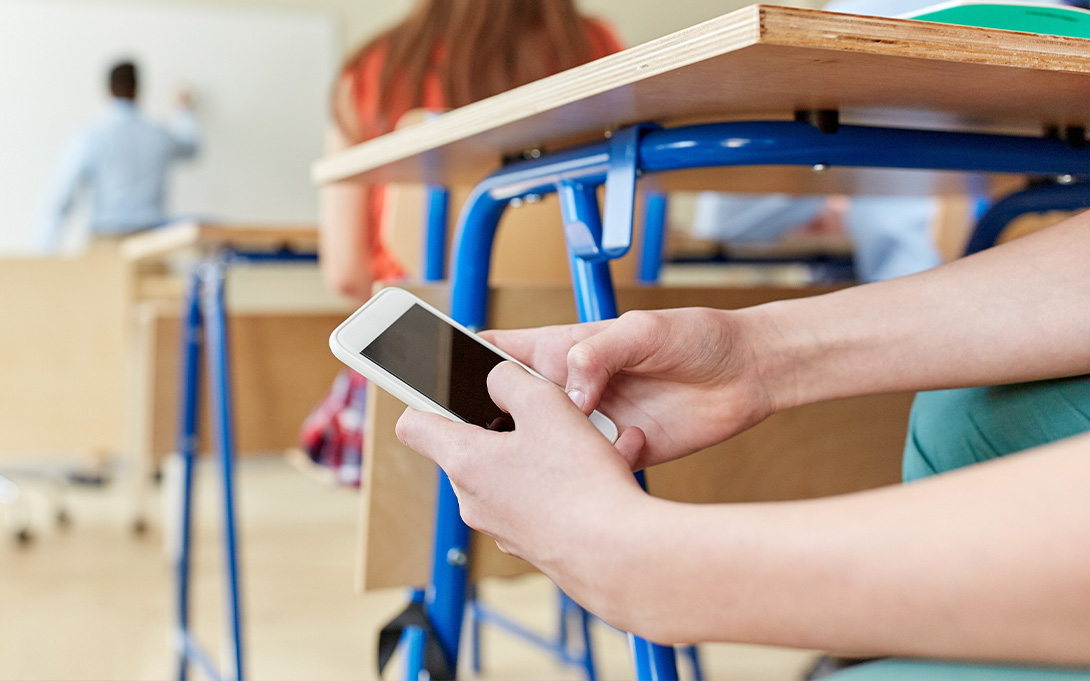
As tablets and laptops have become common classroom tools, schools continue to wrestle with another device: the cell phone.
Cell phones play a critical role in youth social and societal engagement, and schools are seeking information on how best to address their use during school hours. Some argue cell phones should be banned outright, while others see benefits to allowing students to access the devices throughout the school day.
Is there a middle ground? Can schools encourage attentive learning while also allowing students to have access to something so central to their daily lives?
Through separate statewide and national studies, University of Michigan researchers are working to address these and related questions to provide school communities, students, and families with clear guidance.
As a parent of teenagers, Brian Jacob has seen firsthand how difficult it can be for young people to put down their phones. Whether using social media, researching something for school, or texting with friends, students seemingly have endless access to content and ways to engage with others online. But during the school day, how important is it to put the phone away?
"I have heard from my own kids how distracting having cell phones in class can be," says Jacob, the Walter H. Annenberg Professor of Education Policy at the University of Michigan Gerald R. Ford School of Public Policy. "They will be in the middle of a lesson, and the teacher has to stop and ask for the phones to be put away multiple times."
One might think the simple answer is to ban cell phone usage during the school day.
Not so fast, Jacob notes. Despite the risk of distraction during instructional time, cell phones often give students access to important information and tools, including health data, medicine reminders, and safety tip lines.
So, how can schools determine what is best for their students? What evidence shows whether restrictions work and how they impact students?

Enter Jacob and fellow U-M faculty members Justin Heinze and Elyse Thulin. Both are faculty members in the U-M Institute for Firearm Injury Prevention, and Heinze is also an associate professor of health behavior and health equity in the U-M School of Public Health. Heinze's work focuses on youth development, while Thulin studies how technology can exacerbate—or be used to reduce—the risk of harm.
Together, the trio of researchers and their teams are examining not only how students are using phones during the school day, but also what restrictions schools place on the devices and how those policies affect students and staff.
"Before this study, I would have said 'get rid of them', in terms of cell phones in school," Heinze says. "But after starting this project with Brian and his team at the Youth Policy Lab, we know now it is more about finding ways to use the cell phones as productive tools and lessening interruptions rather than removing them completely."
Jacob serves as co-director of the Youth Policy Lab, a joint research center of the Ford School and the U-M Institute for Social Research. Jacob, Heinze and Thulin are conducting a Michigan study of cell phone use and school restrictions, while Jacob is also leading a national study on the topic.
In Michigan, a law enacted in fall 2025 requires school districts to adopt policies limiting student cell phone use, with exceptions for emergencies and academic purposes. The researchers note the law's implementation will vary across school districts, citing the differences in school communities, funding priorities, constituencies, and locations.
What might work for one school might not work for another," Thulin says. "So we are really interested in finding out more about how students use their cell phones during school hours and how that can help inform the restrictions."
Existing research shows policies differ in when restrictions apply, how phones are stored, such as in lockers or lockable pouches, and who enforces the rules, whether teachers or school administrators. These approaches can affect students and staff in different ways, which the team also plans to examine. The Michigan study will gather input from students, school leaders, teachers and parents to consider a range of concerns and perspectives.
"We know from research that students often use their phones for, let's say, medication reminders, other health notifications or technology-facilitated reporting systems," Thulin says. "Their phones can help them feel safe and linked to their support systems, which is important to consider when deciding which restrictions to put into place."
For the national study, Jacob is working with researchers from Duke University, Stanford University, and the University of Pennsylvania to survey how schools in different states are navigating this modern-day challenge. Specifically, they are examining the impacts of school cellphone policies on academic outcomes and student wellbeing.
 What the research shows (so far)
Early evidence on lockable phone pouches suggests that stricter bans may reduce phone use, but they are not a simple fix. Researchers find that the use of lockable pouches:
 Reduced device activity.
 Led to higher teacher-reported satisfaction.
 Changed effects over time. In the first year, disciplinary incidents increased, and student-reported well-being declined. Over time, those effects appeared to fade, and well-being increased.
- Did not lead to notable changes in test scores or attendance or online bullying.
"What is really important, in both the national and state studies, is to get as much information as possible from the very diverse populations we are working with," Jacob says.
We need to understand why certain districts are choosing certain policies and if they are having their intended effect. We also want to see how schools react to the new law—are they simply updating existing policies or adopting new ones?"
The researchers say a multidisciplinary team is essential to studying the issue.
"We all have a different focus, but that is really important in something like this," Jacob says. "By bringing together people with adjacent research interests, we can think about challenges in really innovative ways, and that is what we hope to do."
The team hopes the two studies work in tandem to inform policymakers considering statewide requirements and school leaders evaluating district policies. By developing an evidence base, Jacob, Heinze, and Thulin aim to share rigorous data, promising practices, and resources that school communities can use to help students thrive.

"We really are looking at all outcomes of these policies and restrictions," Heinze says. "Are they reducing school violence? Are they improving student mental health? Are we seeing students more engaged in learning? What behaviors have changed? Are teachers happier? These are all questions we are asking and hope to help answer."
Federal and foundation grants support both studies.
By Kate Barnes
Related Fall 2026 State & Hill stories



← Read all stories in the fall 2026 edition State & Hill
More news from the Ford School